The Human Factor in Software Development
What keeps software architects from their actual work? They stand in the field of tension between diverse stakeholders (management, clients, development team, etc.) and must communicate and mediate in a recipient-oriented way. They must work out solutions with their development team that are implemented with motivation, while also managing the balancing act between budget and quality.
 They must keep an eye on the bigger picture while also being hands-on and practically all-knowing in support everywhere. And all of this with a role that’s often only vaguely defined, leading to differences in expectations, and usually without classic leadership authority, while bearing responsibility for the results as architects. All these circumstances lead to various small and larger conflicts, which we address in this seminar, and above all want to resolve for the future.
Community
In our new community “Soft Skills Connect”, participants from our SOFT seminars network with each other; we share practical experience and talk about challenges that come up in everyday life when applying what’s been learned. Concrete tips deepen the knowledge step by step – complemented by compact information and regular interactive online events with fresh impulses.
Agenda
Defining the Software Architect Role
Working out your own role & interests as a software architect
Examining Stakeholder Interests
Working out the touchpoints with other stakeholders and their interests
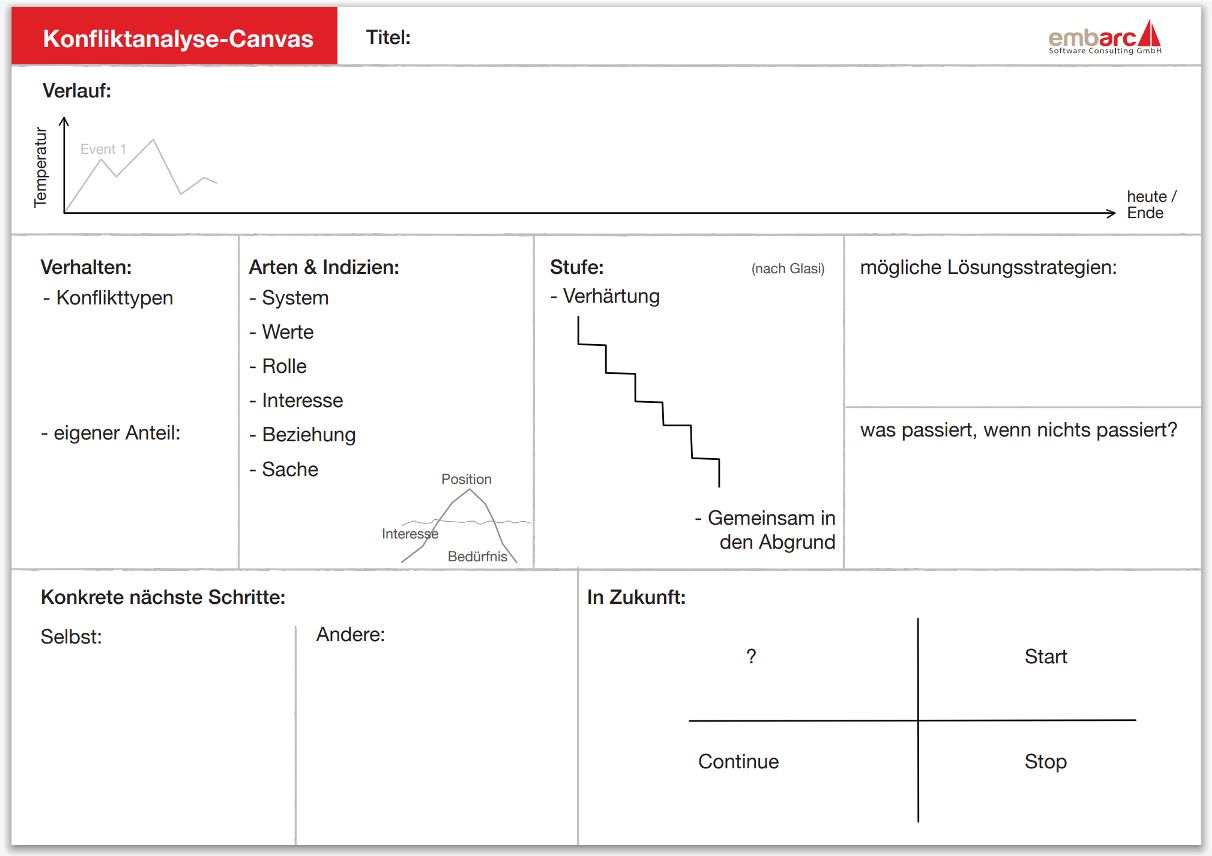
Getting to Know the Conflict Analysis Canvas
Introducing the conflict analysis canvas
Analyzing a Conflict Case
Working through your own practical cases with the help of the individual canvas elements
Developing Constructive Conflict Resolution
Introducing strategies for prevention and constructive conflict resolution (incl. facilitating heterogeneous groups, recipient-oriented presenting and persuading, coaching questions & leading laterally, deciding quickly in the group by consent)
Applying Constructive Conflict Resolution
Applying the matching solution strategies to your own practical cases
Transfer
(Preventive) behavior for early detection and resolution of conflicts in your own practice
Your Benefit
In this seminar, you take away concretely applicable tools for your own practice. We work on your own cases and learn strategies for constructive discussion, facilitation, and conflict resolution.
Target Audience
Software architects, software developers, Scrum Masters, agile coaches, facilitators, managers
iSAQB Accredited
In our seminar, we implement the learning goals of the iSAQB curriculum SOFT in a modern, hands-on and interactive way. On your way to becoming a Certified Professional for Software Architecture (CPSA) Advanced, you receive 30 communicative Credit Points.
Our Extras for You
Photo Log
All exercise results and theoretical content shown are made available to participants electronically afterwards
Official Certificate of Participation
In this seminar, participants are awarded 30 communicative Credit Points for the iSAQB® CPSA-Advanced Level with a perpetually valid iSAQB® certificate.
Additionally...
you receive our own, specially developed conflict analysis canvas in pocket format, which helps you approach confusing situations analytically.