
Why Adaptive Systems?
Rigid systems cannot keep pace with dynamic changes in the domain, the market, or technology. A slow ability to react risks falling behind. An adaptive system combines technical, organizational and methodical approaches to successfully meet these challenges. It enables your company to recognize change early, react flexibly, and keep evolving continuously – as the basis for sustainable success and long-term competitiveness.
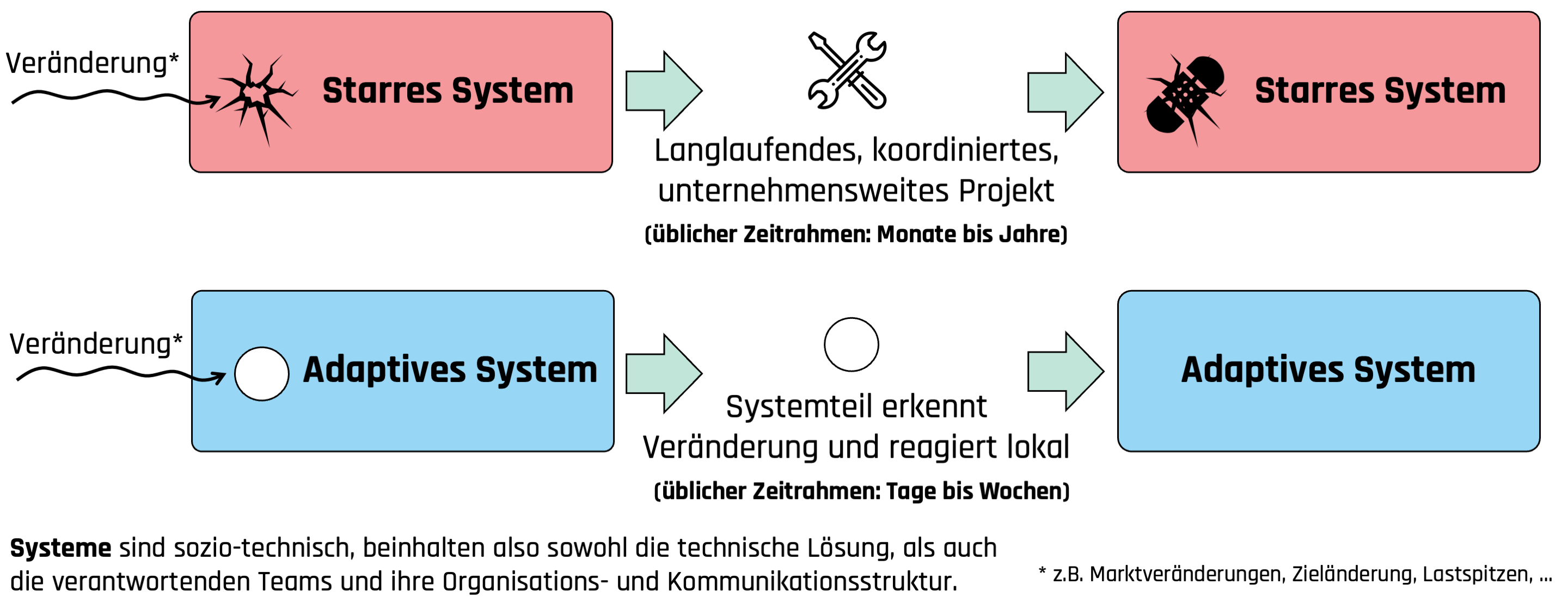
An adaptive system only emerges from an interplay of technical aspects, such as vertical architectural styles with a suitable domain cut, methodical aspects such as establishing an effective feedback culture, and organizational aspects such as supporting development teams through enabling and platform teams.
Principles of Adaptive Systems

Optimize Team Autonomy and Fast Flow
Teams can only react locally and quickly to changes if they have the greatest possible autonomy. To do so, they need to be organizationally and culturally empowered and own modules that are technically decoupled.

Enable Organic Growth
Emergent behavior leads to change in adaptive systems. This often arises from small-scale adjustments, for example in individual modules or teams, and then spreads gradually through the overall system. Establishing and fostering communication platforms, and collecting knowledge and experience in a development platform, helps here.
Manage the Teams' Cognitive Load
Even autonomous teams can be disrupted in their work, for example by heavyweight operational tasks. Ensure suitable areas of responsibility with Domain-Driven Design. Use supporting mechanisms such as platform engineering or enabling teams to provide relief.

Establish Change as a Constant
Technical concepts such as eventual consistency and methodical concepts such as agility help development teams prepare for possibly unexpected drivers of change.
Sense and Respond
Through the right use of self-service infrastructure (for example through the use of cloud platforms), you can effectively detect load spikes and respond to them quickly. Teams can secure their adaptivity by independently detecting change, prioritizing important drivers of change, and implementing them.

Continuous Learning and Experimentation
Through the right use of self-service infrastructure (for example through the use of cloud platforms), you can effectively detect load spikes and respond to them quickly. Teams can secure their adaptivity by independently detecting change, prioritizing important drivers of change, and implementing them.
Our Offering
Combine the best of both worlds: knowledge transfer with direct application in your own context, and accompanying coaching by our experts.
Individual Training
Together, we design a tailor-made, interactive training with you - applied directly to your context.
Content
- Getting to know typical dimensions of change: domain, load spikes, shifting goals, technical or methodical innovation
- Effective feedback mechanisms for quality requirements as a central driver of your product's success
- Implementing and establishing Domain-Driven Design and related methods in your organization
- Distributed architecture patterns such as microservices, self-contained systems and micro frontends
- Team types and interactions from Team Topologies: stream-aligned teams, platform teams and enabling teams
- Technical integration patterns such as event-driven architectures and event sourcing
- Platform engineering and internal development platforms
Consulting & Coaching
Afterwards, we deepen the most promising topics for you and support you through implementation.
Possible Activities
- Prioritizing important dimensions of change
- Aligning your development teams along value streams to optimize workflow
- Fostering domain orientation with Domain-Driven Design by applying collaborative methods such as Event Storming, Domain Storytelling or Domain Message Flow Modelling
- Establishing and aligning platform and enabling teams to optimally support development teams
- Aligning a microservices architecture to development teams to improve workflow
- Identifying effective feedback mechanisms for development teams
- Establishing effective platform engineering and an internal development platform
- Setting up a platform & cloud strategy
Approach
After a three-day individual training, we deepen individual results and support you through workshops and coaching sessions
This approach works best when
- Development teams can only deploy in coordination with many other teams, and long waiting times delay deployments as a result
- Implementing a new feature requires changes in many different places due to high coupling of system parts
- You want to prioritize adaptivity from the very start of a new development
00
Free Health Check
In a free 30-minute health check, we discuss your current situation and identify potential for improvement. Book your first appointment directly below.
01
Planning the Individual Training
In a preliminary discussion, we plan the individual training with you. We discuss your context and a matching agenda and exercises for the training.
02
Individual Training
We run the three-day individual training on-site at your company. With a group of 8 to 15 participants, we cover the most important concepts around “Architecting for Fast Flow” and work on first implementation ideas in your context.
03
Determining Activities
Based on the results and discussions from the individual training, we jointly discuss possible consulting activities and plan concrete next steps.
04
Accompanying Consulting and Coaching
We implement the ideas and first results from the individual training together with you. We support you with activities by conducting regular workshops and coaching sessions with stakeholders and implementation teams.
Did we spark your interest?
Unsere Expertise
We don’t just teach theory, we go straight into practice with you. A topic like “Adaptive Systems” especially benefits from our passion for connecting topics and tackling problems beyond the purely technical.